
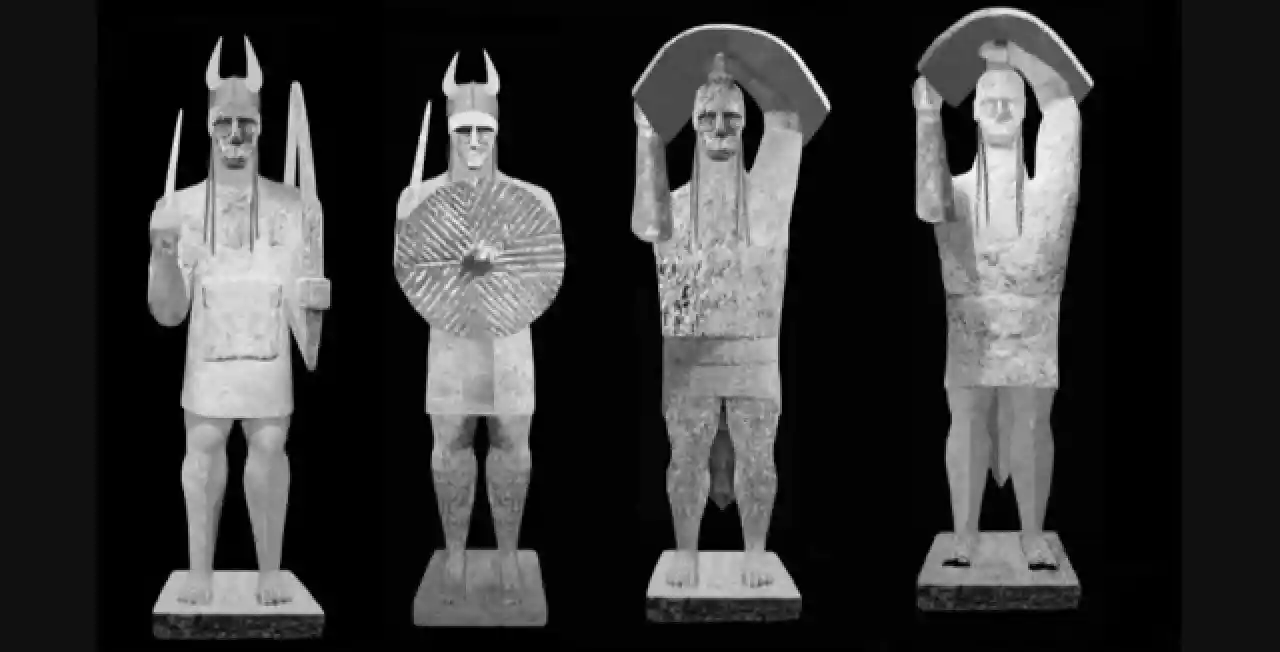
In the heart of Sardinia, just a few kilometres from Hotel Lucrezia, an archaeological discovery has radically changed what we thought we knew about sculpture in prehistoric times: the Giants of Mont’e Prama.
Discovered starting in 1974 at the site of Mont’e Prama, these stone colossi represent one of the most extraordinary artistic testimonies of the ancient Mediterranean.
An unprecedented discovery
The Giants are monumental statues over two metres tall, carved from local sandstone and depicting archers, warriors and boxers. Dated to between the 9th and 8th centuries BC, they are considered the oldest large-scale free-standing statues in Western Europe.
Before Mont’e Prama, monumental sculpture was believed to be the exclusive domain of Greek and Etruscan civilisations. This discovery instead demonstrated that, already in the Nuragic period, Sardinia possessed a culture capable of expressing complex, symbolic and visually powerful artistic forms.
A new vision of prehistoric sculpture
The Giants have redefined the very concept of “prehistory” in the Mediterranean. No longer an era of simple functional artefacts, but a period in which art, ideology and the representation of power found expression in monumental works.
The circular eyes carved with a compass, the solemn postures and the typological repetition of the figures suggest a codified symbolic language, likely linked to ancestor worship or the celebration of a warrior elite.
A heritage still evolving
The Mont’e Prama complex is far from being fully interpreted. Excavations, restorations and studies continue, fuelling international scholarly debate and offering new insights into Nuragic society and its relationships with the wider Mediterranean world.
The Giants are not just statues: they are a turning point in the history of ancient art, tangible proof that Sardinia was a centre of cultural innovation long before previously believed.
Come to Hotel Lucrezia to visit the Cabras museum, which houses the statues, and the archaeological site of Mont’e Prama, where they were discovered.
